


Given a brief to design an immersive technology solution, the airport stood out as an environment that genuinely needed one — a complex, high-volume space where travellers move against a deadline and depend entirely on external guidance, making it one of the strongest cases for immersive technology to add real value rather than novelty.
Existing research confirmed that airport security is a significant pain point for travellers. Faster security checks (45%) were identified as the highest priority, followed by shorter queues (36%), while 18% of travellers wanted dedicated lanes for unprepared passengers. These findings suggested a need not only for faster processing but also for clearer guidance throughout the journey.

S
Waiting time was identified as the primary factor affecting passengers' emotions during airport security. Longer queues increase frustration, uncertainty and perceived time loss, resulting in a more negative overall experience (Kim, Park & Choi, 2020). Based on this research, I focused on three key psychological factors: neglect, waste of time and boredom.
In 2022, average security queue times at Heathrow — the UK's busiest airport, handling over 80 million passengers in 2024 — averaged 20 minutes (Statista).


On the technology side, travellers showed an appetite for digital solutions, particularly virtual queuing (17%) and virtual assistants (13%), highlighting growing interest in technology-supported airport experiences (Booking.com).
XR workplace solutions have significantly reduced the time taken to complete tasks, with companies using AR reporting average productivity improvements of 32%, and a major international airline already using AR to reduce the time it takes to determine if a flight is ready to depart (IBM).

S


Assumption: I could use augmented reality to make the security line more effective.
Insight: Companies using AR have reported average productivity improvements of 32% (IBM). The report validates the assumption that using AR will increase productivity, allowing users to complete tasks quicker — resulting in faster security lines. It also mentioned a major international airport adopting AR.
AR/VR: I selected Augmented Reality as the interaction paradigm, as it was clear this emerging technology had strong attributes that would continue to improve over time, allowing me to take an explorative approach when designing the product.
Use augmented reality to improve the airport security experience by eliminating pain points, increasing efficiency, and reducing traveler stress.
Understanding the Users
I mapped the departure and arrival journeys and scored each stage by stress in a heat map. Pressure built early in departure—security wait times outweighing even check-in worries about overweight luggage—and mirrored this in reverse on arrival. One stage dominated both: the security line acted as a bottleneck, holding stress high until users passed it.
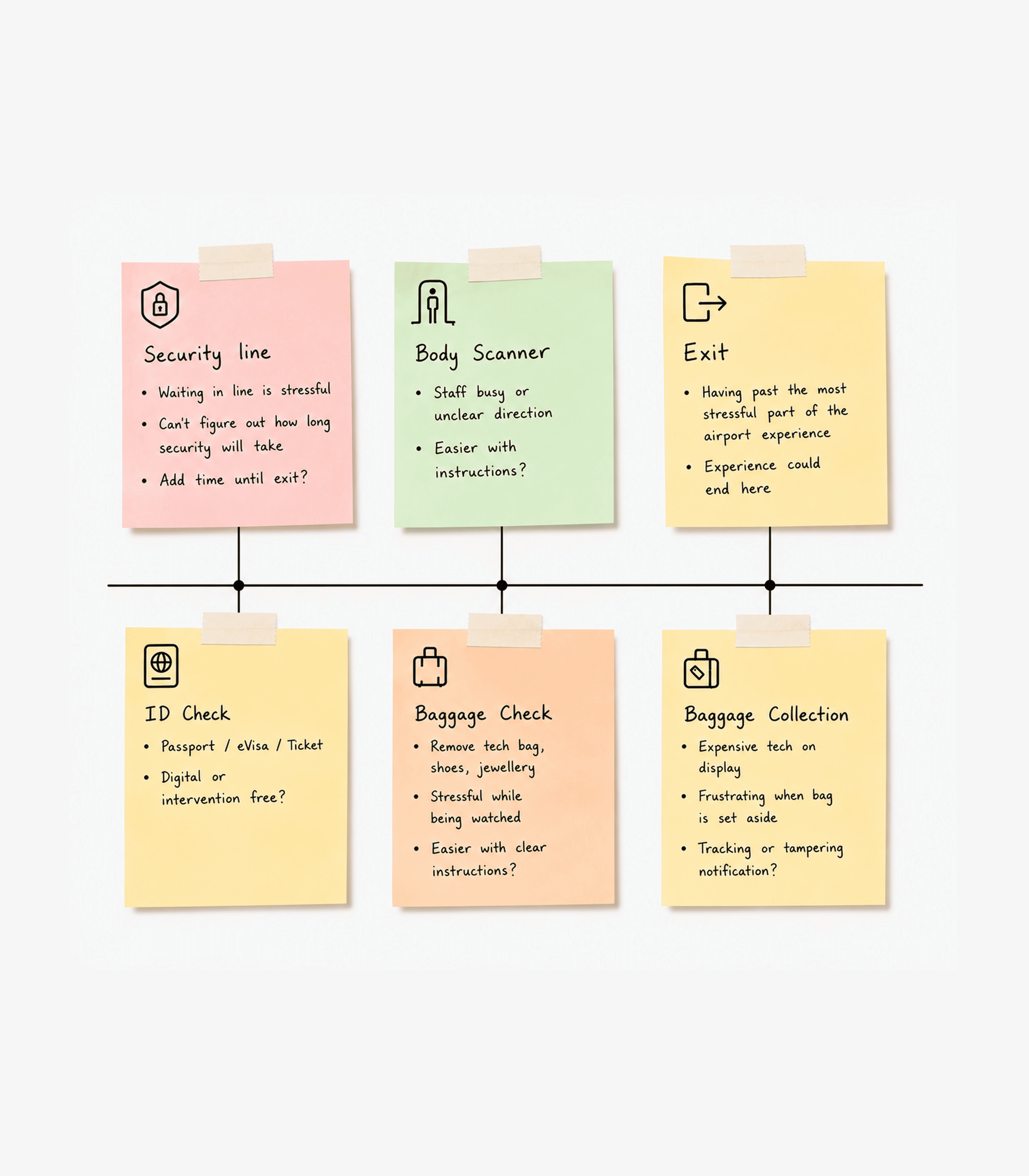
Mapping security as its own journey revealed why: the wait is stressful because it's unmeasured, and unpacking tech, shoes, and jewellery happens under observation with no prior instructions. Each pain point pointed to an intervention—time until exit, a digital ID check, and prep instructions before the belt.

Personas helped ground the design in real user problems by focusing on psychographics rather than demographics. Based on the Rebel, Anxiety, and Late personas, I developed three scenarios to evaluate how the concept responds to different user behaviours and needs in realistic travel contexts.
The Rebel scenario follows Sage, exploring how impulsive behaviour and a desire for independence shape the airport experience. The Late scenario follows Lara, highlighting the pressures of time-critical travel, where efficiency and timely information become essential to reaching the gate without unnecessary delays. The Anxiety scenario follows Ares, demonstrating how uncertainty and environmental stress affect confidence and decision-making throughout the journey.
Image 1–10 veya Video 1–10 bağla
A
The scenarios highlighted key interaction requirements around autonomy, reassurance and efficient decision-making. Moving forward with AR as my paradigm, I used paper prototyping to map both the user's and the staff member's point of view, defining potential safe zones and the interaction touchpoints with security staff. Early on, I framed the concept around core human factors like field of view and inter-pupillary distance (IPD), using these as spatial constraints to position content within natural sightlines and at a comfortable depth, reducing eye strain.
To validate the concept, I ran a focus group discussion with three frequent travellers, using informal, open-ended interviews to explore common travel challenges, understand user behaviours and expectations, and gather early feedback before designing. By focusing on travel routines, pain points, and interactions with airport systems while observing participants' emotional responses, I identified recurring issues around navigation, baggage screening, queue selection, and access to flight information. Participants also expressed a preference for minimal verbal interaction with staff. These insights informed key design decisions, including AR navigation, virtual bag guidance, contextual flight updates, virtual boundary cues, and an emotional indicator.
Image 1–10 veya Video 1–10 bağla
A
Technology Exploration
I benchmarked a range of optical see-through (OST) devices—including HoloLens 2, XREAL One AR, Magic Leap 2 and Ray-Ban Meta—with hands-on testing of HoloLens, Oculus and Google Glass. Microsoft HoloLens emerged as the closest match due to its OST display and interaction capabilities, despite its limited 52° field of view. These findings shaped the technical foundation of the concept, combining BLE beacons for proximity-based, location-aware interactions with a lightweight MobileNet computer vision model to verify items placed in the security tray. I also defined a target hardware profile—dual 120 Hz OST displays, infrared eye tracking, ultra-wide RGB cameras, bone-conducting speakers and haptic feedback—keeping the concept practical, accessible for users with hearing impairments, and adaptable to future wearable AR devices.

Design & Prototyping
Designing for Heathrow, the UK's busiest airport, meant the solution could scale to other airports too. Using a real Heathrow security walkthrough video as a foundation, I sketched over screenshots to build a storyboard around its key interactions. The design system was built on Apple's visionOS, using a glass materials that blends digital and real, SF Pro for multilingual readability, SF Symbols icons, and traffic-light colour coding (red for stop, green for go) to keep the interface focused on communication over aesthetics.
Each component solved a specific friction point: navigation arrows, virtual boundaries for intelligent queueing, AirPass (digitised passport and boarding pass), and a mobile emotional indicator. The system was designed for two users, with a staff-side AirPass that let personnel access approved documents digitally, streamlining interaction rather than removing it. Sound and haptics were considered beyond the visuals: a gentle notification sound to hold attention without stress, and synchronised audio-tactile feedback as a future integration. I animated the components in After Effects to demonstrate the full experience.
Image 1–10 veya Video 1–10 bağla
A
Testing
I used Microsoft Forms to conduct testing in three stages: participant screening, user feedback, and A/B testing. A survey of 12 travellers confirmed the problem space, with security and wayfinding identified as the most challenging parts of the airport journey. Comparing the standard and AR-enhanced videos, positive sentiment increased from 27% to 82%, while 90.91% of participants reported improved understanding. A/B testing refined the placement of navigation, notifications, and visual elements, confirming a preference for minimal staff interaction and self-guided AR, and informing the final iteration with a progress bar, language translation, and improved queue guidance.

A
Image 1–10 veya Video 1–10 bağla
A
FlyFast is an AR airport experience designed to make one of the airport's most stressful stages more guided and efficient. User testing showed strong results, with positive sentiment increasing from 27% to 82% after introducing AR elements, while 90.91% of participants reported a better understanding of the experience. Designed around emerging optical see-through technologies, the concept explores how wearable AR could support future airport navigation and passenger assistance.
Future considerations include a child-friendly AR mode to support young, unaccompanied travellers, multimodal transport integration extending navigation from airport to final destination, enhanced accessibility through voice control and high-contrast visuals for impaired users, and immersive lounge previews of destinations while waiting at the gate.
Gallery
Image 1–10 veya Video 1–10 bağla
FlyFast


